Weld-on bending test (ABV) according to SEP 1390 – Standard-compliant weld seam testing in steel construction

Picture of P. Maseberg
P. Maseberg
Qualitätsmanagement

The weld-on bending test (ABV) is an established mechanical test method in steel construction for assessing the weld seam quality, strength and toughness of load-bearing welded joints. The ABV ensures safety in structures such as beams, columns and load-bearing frames, especially with thicker structural steel plates.

Why is the ABV made?<

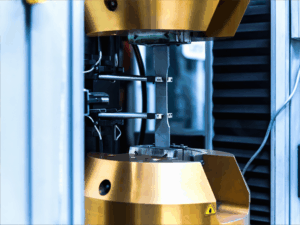
In the weld overlay bending test, a welded sample is selectively bent until it shows cracks or fractures. This makes it possible to determine whether the weld seam and base material remain stable under load – a crucial verification for load-bearing components in steel construction.

The ABV provides important insights into:

  • Welding quality of the joint
  • Toughness of the material and the welding zone
  • Compliance with technical specifications for load-bearing structures

Standards: SEP 1390 and DBS 918002-02

The test itself is carried out in accordance with the technical test specification SEP 1390. This describes in detail how the sample is prepared and tested in order to enable a reproducible assessment of the weld seam and material properties.

For classic steel construction, DBS 918002-02 (Deutsche Bahn – technical delivery conditions) provides specific requirements for testing structural steel sheets. According to DBS 918002-02, the weld-on bending test must be verified in the factory for structural steels of grade S355J2+N if the sheet thickness is greater than 30 mm.

How does the weld-on bending test work?

  • Sampling:
    A section of welded sheet steel is prepared for the test.
  • Welding:
    A weld seam is applied to one side – this is the area to be tested.
  • Bending test:
    The sample is bent slowly until cracks appear or a defined deformation is reached.
  • Evaluation:
    The weld seam and the adjacent material are examined for cracks or brittle fractures.

The aim is to show that the welded joint remains stable even under bending stress and that no critical failure modes occur.

Practical example from steel construction

Steel construction projects such as hall girders, bridge profiles or support structures require reliably tested welded joints. Particularly with thick structural steel plates (>30 mm), an inadequate welding process can lead to cracks under load – with high risks for the structure.

The ABV allows you to:

  • Verify the quality and safety of the weld seam
  • Recognize risks of material failure at an early stage
  • Document compliance with standards for clients and inspectors

Conclusion

The weld-on bending test in accordance with SEP 1390 is a central standard test in steel construction for objectively testing the load-bearing capacity and toughness of welded joints. DBS 918002-02 stipulates that this test must be carried out on structural steel sheets with a thickness of over 30 mm if the weld seam and material strength are to be verified. The ABV thus makes a decisive contribution to safe and durable steel structures.


More news