Offshore steels are subject to significantly higher requirements than conventional structural steels. Extreme environmental conditions, low temperatures and dynamic loads make targeted material selection essential. EN 10225, the NORSOK requirements and additional options such as the tensile test in the thickness direction are particularly relevant here.
But what do these terms mean in concrete terms – and what is really important in practice?
Why offshore steels need special properties
In the offshore sector, there are loads that hardly occur in classic steel construction:
- Low operating temperatures, often down to -40 °
- Dynamic loads due to wind, waves and operation
- Corrosive environment due to seawater and salty air
- High safety requirements for load-bearing structures
Conventional structural steels such as S355J2 quickly reach their limits here. Offshore steels are specially designed to function reliably over the long term, even under these conditions.
NORSOK – increased requirements for offshore constructions
NORSOK is a Norwegian set of rules for offshore structures that was originally developed for the oil and gas industry. It does not define a separate steel product, but specifies additional requirements for materials, production and testing.
Typical NORSOK requirements are
- Very high notched impact strength, often at -40 °C or below
- narrow limits for the chemical composition
- Increased requirements for testing and documentation
- Special consideration of suitability for welding and the heat-affected zone
In practice, these requirements are often implemented on the basis of offshore steels in accordance with EN 10225.
EN 10225 – the central standard for offshore steels
EN 10225 is the authoritative European standard for hot-rolled structural steels for offshore applications. It defines:
- Mechanical properties
- Toughness requirements
- Test procedure
- Additional selectable requirements (options)
Common strength classes are S355, S420 and S460, each with special additional markings for offshore constructions.
Additional marking of EN 10225 – G, GP and G1 to G4
The additional markings provide information about the requirement level of the offshore steel:
- G: Basic requirements for offshore applications
- GP: For primary constructions with increased safety relevance
- G1 to G4:
- Increasing requirements for notched impact strength
- Suitability for lower temperatures
- Higher requirements for large sheet thicknesses
The higher the additional mark, the stricter the requirements for material quality and testing.
Options according to EN 10225 – Customize off-shore steel
In addition to the basic requirements, EN 10225 allows additional options to be agreed in order to adapt offshore steels precisely to the respective application. These options are particularly important for thick-walled and highly stressed structures.
Typical options for offshore steels
Tensile test in thickness direction (Z quality)
This option is used to evaluate the properties perpendicular to the rolling direction. It reduces the risk of lamella cracks and is particularly relevant for:
- large material thicknesses
- heavily stressed weld seams
- complex supporting structures
Extended impact tests
Additional tests at lower temperatures or at several sample positions ensure a consistent level of toughness.
Stricter ultrasonic testing
Increased requirements for ultrasonic testing help to detect internal material defects at an early stage.
Adapted chemical composition
Limitation of carbon or sulphur content to improve weldability.
Extended documentation
Project-related test plans and detailed acceptance test certificates increase traceability and safety.
These options make it possible to design the offshore steel to suit requirements without incurring unnecessary additional costs.
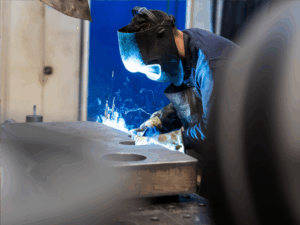
Suitability for welding – a decisive success factor
Welding plays a central role in offshore constructions. Offshore steels according to EN 10225 are designed in such a way that:
- the heat-affected zone retains a high toughness
- the risk of cracking is minimized
- the mechanical properties remain reliably fulfilled even after processing
Controlled processing is crucial, especially in connection with NORSOK requirements.
Typical applications of offshore steels
Offshore steels are used, among other things, in:
- Offshore wind turbines
- Jacket and monopile structures
- Jack-up rigs
- Port and coastal construction
- heavy steel and plant construction
Conclusion: Select the right offshore steel
Offshore steels according to EN 10225 offer the necessary safety for structures in a maritime environment. With additional options such as the tensile test in the thickness direction and, if necessary, NORSOK requirements, they can be precisely tailored to the respective application.
The decisive factor is not the maximum number of requirements, but the right combination of standard, additional markings and options – tailored to the operating conditions and design.